Sunday, 25 October 2015

Howard Jacobson: "men who read won't rape"

I've never read Howard Jacobson's novels. It's probably not his fault. I try not to read contemporary novelists: I inadvertently (though fortunately) read Wolf Hall and I can imagine myself reading Money this side of Martin Amis dropping dead, but other than that, I prefer to read the works of the deceased. I basically want to read them without the need to know what side they're on, what stance they took on Syria or Iraq or God or even, if I can help it, Vietnam, and this is a lot easier when they're gone and even their trangressions are by and large forgiven. It's true, I read What A Carve-Up! several times and gave copies as gifts to several people, but that was before I came up with this particular self-denying ordinance. I'm a librarian by profession and I read for the peace and quiet, not the noise.

Howard is, unfortunately, also a columnist of sorts. The Independent publishes his piece - weekly, I think, though I'm not interested enough to check, let alone to know, and besides, the battle of the columnists , what Nick says about what Polly said about that piece by someone else,  is part of the noise I'd rather avoid. But I did catch this, last month. It's Howard Jacobson on Cambridge, the civilising effect of improving literature, and women. His thesis, roughly, is that men who read won't rape. Yes, that's precisely what I wrote. He says that men who read won't rape.

It's worth reading in full, although in another way, it's not worth reading at all, but once started, it has to be finished just to see if he's really saying what you think he's saying. It's a meander rather than an argument, since Jacobson, whatever his skills as a novelist, can't really maintain a linear argument for the length of a two-minute column. Nevertheless, that two minutes is long enough for some startling passages to stand out. Here's one:
because my college was for men only – some joke, calling us “men” – there were no women around for us to abuse, supposing we’d been of a mind to do so.
OK. Now in my experience, humour, even offhand humour, about violence against women isn't usually leading to a good place, but Howard's a proper writer and I am not, so let's follow him awhile before we make our judgements. Where are you going with that thought, Howard?
There’s more than one way of being brutal. But we never raised our hands to women. We could no more have date-raped than scored a try at Twickenham.
All right, Howard, that sounds like self-deluding garbage about the past to me, but both of us are middle-aged men and we can be forgiven our lapses of memory, even when they are to our advantage. But why, since you raise the subject, would you and your contemporaries have been so trustworthy with women, compared to young men generally?
In the case of those of us who studied literature, the books we read turned us inward and kept us civil. It would have been hard to go from reading Jane Eyre to inveigling totty back to our rooms and doing violence on them.
Now at this point, if columnists are still capable of making you angry rather than glaze over, this might be the point at which the anger rises. He is saying what he is saying. He is really saying that. He is saying that because you read English Literature, you would be much less likely to rape.

Jesus. Somebody actually wrote that in a newspaper. Scarcely anybody noticed, as far as I could see - it was a Friday column and the weekend went by without any particular public outrage - but somebody, a Booker Prize winner at that, wrote in a newspaper that rape is much less likely if you read English Literature at Cambridge.

Where to start with such a column? Where to start with such a claim? With my own personal experience of Oxford students, which - twenty years later than Jacobson - was that the men were just as boorish, just as beery, just as hateful towards women when they wanted to be, as any other set of men I've come across? With my recollection that English Literature at my college was in part represented by a chap who despite his doubtless sensitive and life-enhancing knowledge of the English funeral elegy from Spenser to Milton (though he, in fact, had played at Twickenham) had no particular reputation for keeping his hands to himself?

Here's Clive James, who, in comparison to Jacobson, had some idea of what power relationships on campus might entail.
Almost every university department I have ever heard of is haunted by at least one Lothario who sees nothing wrong with trying to screw the prettier students. The concept of academic freedom usually ensures that such conduct goes unpunished, even though it is patently unfair to the screwed and the unscrewed alike.
At least Clive James could see what actually happened among his university contemporaries. Jacobson has, or claims to have, no idea.
Yes, we called them “totty”, but we would have died from embarrassment had the totty looked in our direction.
Jesus. "Yes, we called them 'totty'". But...but nothing. You were afraid of women? Are you under the impression that being afraid of women means men are less likely to rape? Are you insane, Howard Jacobson? What are you thinking of? And what were they thinking of, whoever nominally edited the column and decided it was fit to publish?

Of course, what would probably have happened if James' "Lothario" had raped a female student, or if a young male student (who perhaps spent the rest of the evening reading Sons and Lovers or Jane Eyre) had raped a local girl, would have been that they would have got away with it - and not especially because of "the concept of academic freedom". They would have been believed and the female student, or the local girl, would not, and why? Because one of the people concerned would have been viewed as "totty" and the other would have been a man. And at that, a "refined" man. one who went to King's, who knew nothing of the "obscenities of the uncouth North", who had read DH Lawrence and Charlotte Brontë.

There's much more that could be said about the piece - try, for instance, getting your head round the claim that follows
I don’t say an MA in gangsta rap or business studies will necessarily make you a rapist, but there’s less mental distance to travel before you get there
or the immense, self-pitying, could-not-be-further-wrong stupidity of this
is it even possible that we have given up on the idea of being humanised altogether? Is the very word too fancy? We mistrust whatever isn’t egalitarian and look askance at people who appear to us to live in ivory towers
but to deal with it point-by-point might be to do more justice to it than it merits. It is a hymn to education, the text of which is soaked in ignorance. It is a set of falsehoods about rape, culture and education. It is a lie.

As I say, the lie came and went without a great deal of notice being taken. All right, the weekend after was the one Jeremy Corbyn was elected and nobody was much interested in anything else. The day of its publication was 11 September and there were more important things to pay attention to that day than the crass stupidity and snobbery of a two-minute column. And yet Jacobson's columns do get praised, passed on, embedded in tweets which recommend their contents. They get read. They are looked forward to. How could it be that nobody noticed, that particular day, what this particular column had to say?

I don't know. I don't even think I seek to know. But I do know that whatever Howard Jacobson's experience at Cambridge, and whatever mine at Oxford, although the both of us were silly young men who knew nothing about women, neither of us had to go through anything like the experience of being raped, nor beaten, nor that of not being believed afterwards. Jacobson doesn't think it happened, not back then when
we never raised our hands to women.
I think they did, Howard. I think they did. But I think it was "refined" people that did it.

Sunday, 18 October 2015

An unrelaxing café con leche

In Spain we have something called the Ley Mordaza, or Gag Law. You might have heard of it: or you might have heard about the protests which is is designed to stop, the wave of protests against corruption, evictions and what-have-you that began on a large scale with the movement of 15 May 2011 and which counts among its political consequences the existence of Podemos and the election of Ada Colau.

In response, the Ley Mordaza: a remarkable and clever piece of legislation which prevents protest indirectly, not by bludgeoning protestors off the streets, though the bludgeons are there all right and more than occasionally used, but by emptying their pockets. Some of the fines involved are eyewatering: as listed by The Local, they include, for instance
between €30,000 and €600,000 if the protest takes part near institutions such as the Spanish parliament
and similarly
people trying to stop an eviction from taking place could be fined between €600 and €300,000.
In The Glass Teat, Harlan Ellison, then part of another, older protest movement, writes of his frustration at the surtax charged to Americans in order to pay for the war in Vietnam:
I draw the line. I make my stand here. I deny them the funds to kill. And my CPA shook his head sadly at my naïveté. Boob, he said politely, you won't go to jail: they will empty your bank account. I will empty the bank account, I said, knowing what hassles that would make for myself. Then they'll attach your wages, he responded. Then I'll - I stopped. It was hopeless.

So it is. People might be prepared to go to prison for the right to protest: that way you're achieving something. If all they do is take a chunk of money off you - and a hefty chunk, at that - then what are you achieving? That way the state creates no heroes and no martyrs, unless you're expecting people to march under the slogan Pay Back The The Huesca Three instead of Free The Chicago Seven. They're probably not going to do that. They'd only be fined themselves if they did. And there's a limit to how many fines a movement can pay by crowdfunding.

So we wait until after the election of 20 December to see if our civil rights will be restored to us, my guess being that unlike the Kings they won't be coming our way after Xmas. Meanwhile, since the Law appears in the short term to have achieved its desired effect of preventing protest by deterring it, it's the petty aspects of the legislation that have attracted most attention, the way in which it penalises and persecutes not just the overtly political but the normal and everyday.

Naturally in doing so it makes the everyday political. It intrudes the repressive function of the state into the everyday life of the citizens, the very thing the Transition to democracy, or indeed any liberal democracy in general, is supposed to avoid.

To return to The Local:
Showing a "lack of respect" to those in uniform or failing to assist security forces in the prevention of public disturbances could result in an individual fine of between €600 and €30,000
and
People will be fined for taking unauthorised photographs of the police
For sure, the first of these is supposed to penalise political louts (like the present writer) with a tendency to speak disrespectfully of people in uniform, while the latter is aimed ostensibly at YouTube videos of police officers, since these videos tend to show them bringing out the bludgeons that I mentioned earlier. But it also makes it impossible for journalists to carry out their normal job. All of a sudden it is potentially punishable to capture and publish images of police officers, the very thing we expect journalists to do, on behalf of the taxpayers who pay for those police and the citizens who the officers are supposed to represent.

More than that, it means that ordinary people, doing ordinary things, suddenly find that they have committed political acts - punishable political acts - and that they face stiff financial penalties for doing so. A man on Tenerife criticises the police on social media: a few hours later he's notified that he'll be fined for it. A woman in Alicante province takes a photo of a car parked in a disabled bay and puts it on Facebook. What could be more normal in 2015 than that? But the car wasn't John Terry's but a police vehicle - and they threaten to fine her eight hundred euros. Suddenly the everyday is illegal.

Then there was the chap in Málaga province who, finding his way blocked by a parked vehicle, and having called the police station and received no reply, went onto Facebook and wrote:
Es la una de la mañana, estoy llamando a la policía y no está operativa, pero sí que toman café en el pueblo de al lado.
Or something like that, since soon afterwards he deleted it. A rough translation:
It's one in the morning, I'm calling the cops and getting no reply. No doubt they're next door having coffee in the village bar.
The reason he deleted the posting was this this was deemed "un falta de respeto", an act of disrespect, and he too has been threatened with a fine.

What's funny about this, funny ha-ha until you realise it can happen to you, is that he was in all probability right. The police are always in the bar drinking coffee. If you go into a bar your chances of seeing a group of police officers are pretty good, so much so that it's a standing joke with the two of us. Either "our friends" are there when we arrive, or they arrive when we're already there: and given that we travel round Spain to make a living, this isn't down to coincidence (I say so because by coincidence, the bar in the village down the road is right next to the Guardia Civil) but down, rather, to the fact that the police in Spain spend a lot of time in bars.

I don't particularly have a problem with this. They drink their coffee, check their smartphones and look at MARCA: I drink my coffee, check my smartphone and look at MARCA. No bother. But it shouldn't cost somebody hundreds of euros if they say so.

In fact, shortly after I came across the story about the bloke in Málaga province - I think I saw it in El País - I was in a hotel bar with half-a-dozen police officers. I was at a table and they were at the bar, as they usually are when we stay at that hotel. By and large it serves commercial travellers, like ourselves, making overnight stops in a convenient place just off the Barcelona-Madrid motorway. So there's traffic police about, and of course they want somewhere to stop, de vez en cuando, and have a rest. Like I say, no problem.

But it amused me that I should see the story, about police officers objecting to the idea that they'd be drinking coffee in the bar, just as I was in a bar, drinking coffee, with a number of police officers. So I reached for my smartphone with the intention of taking a photo or two, just to send to R with some kind of amusing message. Police officers at the bar: who ever would have thought it? Something to that effect.

And then I stopped and said to myself - what on Earth do you think you are doing?

Sunday, 11 October 2015

Nothing out of the ordinary


I went to a comp. Course I did. There's nothing special about it: there's nothing about it that marks you out. Going to a comp was normal. Nearly everybody did.

It was unusual as a comprehensive went: it was a Catholic school, and single-sex, but other than that it was, in intake and admissions policy, the same as everywhere else in Stevenage, much as all the housing estates in Stevenage looked like everywhere else in Stevenage. Buses arrived at the school from further afield, from as far away as Royston where a Catholic junior school provided part of the school's intake and two-thirds of its chess team. But the only thing you'd have thought was different about us, had you visited the school from any other in the town, was that there were no girls among the pupils. Other than that it was normal. It was the normal. It wasn't a kind of secondary school. It was what you understood when you thought of secondary school.

There was nothing particularly proletarian about the school, nothing much that spoke of poverty. There didn't need to be. If you were poor or working-class in Stevenage, you went to a school like ours: if you were middle-class, you went to a school like ours. It was normal. Not bog-standard, just normal - and just as normal if your parents had two cars and lived in a detached. You'd  be aware that there was such a thing as private education and you might even have been in one on one occasion or another. (We played in chess matches against public schools.) But I didn't know anybody who went to one. Saying "I go to a comprehensive school" meant nothing: you might as well have said "I watch the television", were it not that I did know one boy whose parents didn't have a television.

You get the point. If you're trying to say something about your background, you can't say very much just by saying you're from a comprehensive. From Liverpool or Stevenage, it probably says "my folks weren't rich". No more than that. It's not an index of deprivation. It's not an index of anything, save normality. It wasn't till I found myself at Oxford, where only about a quarter of the undergraduates had been to comprehensives, that it seemed to be anything else. Then, it set you apart, or could do, in that insidious way, mattering only if people wanted it to matter, mattering only when you found you didn't fit.

I had a joke, when I was there, that if somebody said they'd been to a state school, it meant they'd been to a grammar school, since if your background was a comp, you said as much. The difference between grammar and comprehensive seemed larger than the difference between public school and grammar. But neither before nor since has it meant anything at all, if I said I'd been to a comprehensive.

So you can't say you went to a comprehensive, as if that conveyed something about you. It does no such thing. It may say something about other people, about the place where you have arrived. But in itself, it just says: I was ordinary. Not "I was poor", but "I was ordinary": and "ordinary" - provided you were from a county without grammars - meaning "in the ninety-odd per cent who didn't go to public school". Which included most of the middle class, the professional classes, whatever you chose to call them - kids with well-off parents, kids whose parents were anything but natural Labour. It also included a lot of poorer people, people who would have seen Labour as their natural ally, at least before Labour, pre-Corbyn, ceased to think the same of them. But both these sets of people went to the same schools. It wasn't education that divided them.

There's a question to be asked, about why people who once identified with Labour cease to do so. It might, though, be that there is nothing unusual about people who have done well for themselves, whose circumstances of life have changed, finding that the feelings in their gut have also changed. To say so is to make no judgement, other than the one made by experience - people become less leftwing as they get older, and all the more so if they move up socially. It's not a bad thing or a good thing, just a thing.

But it's about them, not about the school they went to - and the point of invoking the school is just another origins story, like those attached to US presidents, like almost any invocation of class in an aspirational society. It says "this is where I came from, and this is where I am". It says, implictly, "this is what I have achieved", and no less implicitly, "and so could you". And whether it wants to or not (and Jane Merrick really wants to) it says, also, "look at me".

But it doesn't say anything about comprehensive schools, because of what a comprehensive school is. Or was. Mine was: after I left they closed it down, or rather, closed the site and merged the school with the Catholic girls'. And after that


they burned it to the ground.

Sunday, 4 October 2015

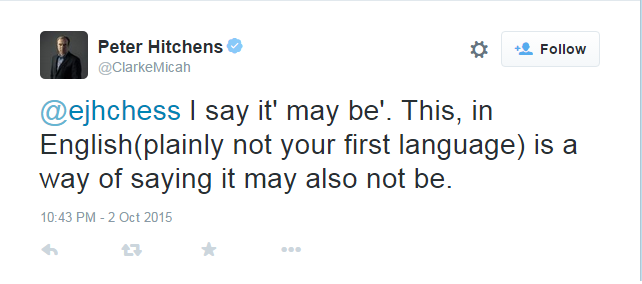
An evening with Peter Hitchens

I had a Twitter ruck with Peter Hitchens on Friday night. Very small ruck. Nobody hurt. Quite peaceful for a Friday night.

He's a boorish guy, Hitchens, which is what surprised me, since he has a reputation for courtesy when expressing differences of opinion. Perhaps he's a nicer guy in a person than he is on the internet: most guys probably are. I'm certainly not.

It was his style of boorishness that interested me. Not abusive, but not quite condescending: just calling me stupid, without actually using the word. A very middle-class way of being obnoxious, quite suitably so for somebody who vests his hopes in the middle classes. Can't you read? says the highly-educated man to the shop assistant who has made a simple error, knowing very well that the shop assistant reads just as well as he does, but taking the opportunity to call him stupid and put him in his place.


There's something substantial to be written about sneering as a habit, about the sneer as a mode of address, though I don't suppose I'll ever be the one who writes it. The sneer's the way in which the educated speak of the uneducated, the insiders of the outsiders, the middle class of the lower ranks, the successful of the unsuccessful. Both of and to, in truth, though only to when the victim is in no position to retaliate. But that's the idea: to stress position. Speaking down to people affirms their status and your own. It expresses and insists on it. Why do I speak to you like this? I speak to you like this to show that you are not my equal.


The sneer loses its effect online. Online abuse is different: it seems to magnify itself in the absence of the physical person. But call somebody stupid online and you just look like you're playing in the playground - which is where the habit originates, in making the other kid feel small for not being one of your gang. (Or, perhaps, in having been made to feel small: the boy who was kicked is father to the man who does the kicking.). But that's not entirely fair, since it's as much an adult absurdity as a childish one: the pompous man losing his dignity, and losing it the more, the more he thinks he's keeping it. The customer calls the shop assistant stupid - but what if then, the shop assistant laughs and shrugs his shoulders?


It's a shame, since I'd have liked to see the conversation go where it was headed, before Peter started getting pinned down by his argument and lashing out to try and free himself. It would have been intriguing, at the very least, to see his argument develop, that gun rampages are best addressed by the death penalty (which the US has, and the UK does not) and can be linked to drug use (which is as common outside the US as it is within it). A hard position, in principle, to defend against reality.

But that's the nature of contrarianism, a combination of genuine insight and wild exaggerations-for-effect, and woe betide you if you point out that the contrarian is exaggerating for effect, since it's then that the screaming teenager reveals itself within. It's an immaturity that goes with the approach, since it's a sixth-form-debating style, getting away with what you can get away with rather than trying to tease out what is true. But if you do it right, and do it for the right people, you never need to change it. Nor do you ever need to change the person underneath.

It's half a farce to cast myself as the shop assistant in that story, though only half, since I have been a shop assistant, which I don't suppose that Peter Hitchens has. But I also have an education, academic and political, a lot like the one the young Peter Hitchens had. And I recognise this habit, the one of trying to look down on other people, of making other people feel small, not just in Peter Hitchens but also in myself. You have to be yourself, we say to one another, but you don't have to like it, and it's when we see ourselves in others that we like ourselves the least.

Well, education is no substitute for knowledge of yourself, and formal education doesn't help you get there. Perhaps the opposite: nothing is less likely to make you look at your own flaws than the knowledge of being successful, of having scored more highly in exams than other people, of having reached a higher status, of having achieved more success. These are things which lead you to compare yourself to other people, to their discredit and your own advantage, not to look within. Not to ask yourself the question - how do I treat other people?

But these are the things we value: not self-knowledge, but exam results, money, success. And money is no mirror to the people who have got it.

Sunday, 27 September 2015

Angela's ashes

I went to see Rayo beat Sporting on Wednesday, as I happened to be working in Vallecas in the afternoon. I walked downhill to the ground and bought a ticket for the highest part of the north stand, intending to sit with the home fans but find myself instead in a mixed section with a preponderance of supporters from Gijón. I suppose the bloke in the ticket office thought I talked funny and couldn't be from round those parts. He wouldn't have been wrong.

I'd mostly hoped for a good view of the Fondo down to my right, which on my previous visit had been full of banners, political ones (what with Vallecas being a magnet to squatters, anarchist and radicals - DEMOCRACY, EXPROPRIATION AND EXECUTIONS, demanded one wall-slogan I went past on the way) and supporters bouncing up and down all evening. But this time they mostly sat, and the view in front of them was empty of banners. In one way or another I was disappointed, though not disappointed by the game, and still less disappointed by the view.


On the way to the ticket office I stopped, in a big concrete playground just behind the south stand, to read about Jonestown. I'd not planned the afternoon that way, but wandering the internet during a slow afternoon for sales, I'd come across an article on Vice which mentioned
the audio records made during the Jonestown massacre
and having never previously known that such a record existed, I went looking for a transcript. But just the transcript: I wouldn't have risked a deposit on my motives for reading it in the first place, but as for actually listening, Sean Munger's advice seemed wise at a time when a little bit of wisdom was what was needed.
I strongly suggest you don’t listen to it on a whim or just out of morbid curiosity. It may change you in ways you don't anticipate. It's not like a horror movie or after-the-face evidence of a massacre that took place in the past, like footage of the liberation of Nazi concentration camps, horrifying as that is. This is the sound of 900 people dying, many of them children.
Better left for a better day, with a better reason, is what I thought.

I remember Jonestown, though only with vagueness, something that one heard on the radio in childhood and had no context in which to place it except that. I didn't know who Jim Jones was, could not have identified him in a photograph: nor did I know where Guyana was, could not have found it in an atlas without looking at the index.

Until Wednesday night I don't think I'd learned very much more than that, not unless I'd learned it and forgotten. So I hadn't realised, or it hadn't registered, that Jonestown was as much a political community as it was a religious one, that Jones had a long history in civil rights and anti-racist struggle, that he included the likes of Harvey Milk and Jerry Brown among his admirers. And I hadn't realised that they'd received messages of support over the radio from Angela Davis.

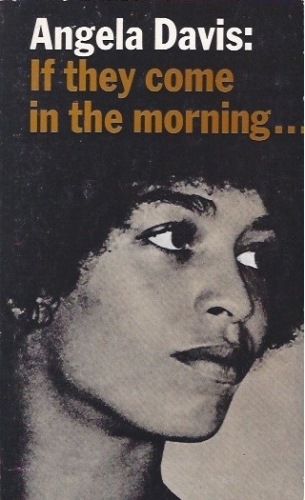
We shouldn't feel personal about historical figures, people who we never knew and who took their actions, for good or bad, without the slightest knowledge of us. And their reasons can't be ours: what they saw through their eyes was not what we see through ours. But still, we take a view on those who shape us, and one small thing that shaped me, not very long after Jonestown had happened, was finding If They Come In The Morning on the shelves in Stevenage Central Library, as randomly and serendipitously as, thirty-five years later, I would find the Jonestown transcript.


The theme of the book is, above all, the incarceration and the unjust treatment of America's black citizens by its police, judicial and penal system, published in 1971 and relevant today. It was one of my first introductions to the theme of injustice, just as, one imagines, the casual shooting of black citizens by American police, and their subsequent exoneration by the courts of justice and of white public opinion, could be to a teenager today. So when I was deciding for myself what I should be, what should guide me in my life and views and actions, one of the people who shaped me was Angela Davis. This was not her fault.

If you ask me about the struggle now, I am liable to say that life itself is a losing struggle. I might go on, if I am encouraged, to propose that among the risks any young radical is running is the risk of changing their mind in mid-life - and then spending the second half as a professional bore, making permanent war on one's former comrades and one's former self.

It is of course a first world luxury, to trouble oneself about bores instead of concentration camps, but for all that, may God save us from epiphanies and from the bores who have them. And let the god who watches over middle-aged men and their discontents preserve me, too, from ever having an epiphany - though if I were ever to have one, it might be Jonestown that sets it off, the massacre, the madness, the willing or unwilling suicide of nine hundred leftists with their children.

I wish Angela Davis had not spoken to the members of the temple, offering solidarity to a cause that shouldn't have existed. Or maybe what I really wish is that I didn't know that she had spoken. Either way and every way, I do not think that I will listen to that audio.